

Mosquito Control Service in Wake Forest, NC
If you’ve stopped using your back porch between May and September, or your kids come inside covered in bites after ten minutes in the yard, mosquito pressure has crossed the line from annoying to genuinely limiting how you use your property.
Wake Forest has a specific mosquito problem that stems from its geography. The combination of Falls Lake nearby, the heavy clay soils in older neighborhoods that hold standing water, and the dozens of new subdivisions built on cleared land with drainage that’s still working itself out — all of it creates ideal mosquito habitat right in the middle of residential areas. This isn’t a problem that improves on its own.
Distinct Lawns provides professional mosquito control barrier spray treatments for homeowners in Wake Forest, Heritage Wake Forest, Holding Village, Hasentree, and surrounding areas. We’re locally owned, licensed, and have been treating lawns in this area long enough to know which parts of town have the worst mosquito pressure and what actually controls it.
Why Wake Forest Has a Mosquito Problem
Mosquitoes need standing water to breed. They can complete a full breeding cycle in a bottle cap’s worth of water given enough warmth and time. Wake Forest has standing water in abundance — and not always the kind you can see or eliminate easily.
Falls Lake and its tributaries
Falls Lake Reservoir sits just west of Wake Forest and its drainage network runs through the city. Smith Creek, Richland Creek, and their tributaries create natural low spots throughout Wake Forest that hold water after rain. You don’t need to live on the water to be affected — mosquitoes travel up to a mile from their breeding sites, and a single productive breeding area near a creek can sustain a large local population through the entire summer.
New construction drainage
The rapid development across Heritage Wake Forest, Holding Village, and the corridors along Burlington Mills Road and Rogers Road has left a lot of disturbed land with drainage that’s still settling. New subdivisions often have low spots that collect water after rain — the kind of shallow, warm puddles that mosquitoes breed in most efficiently. Until drainage fully establishes in these areas, mosquito pressure in newer neighborhoods tends to run higher than established ones.
Clay soil and surface water
Wake County clay doesn’t drain quickly. Water sits on the surface longer than it would in sandier soils — in natural areas, near downspouts, in low spots in the lawn, and under dense tree canopy where evaporation is slow. All of it becomes potential mosquito habitat from May through October.
How Our Mosquito Control Service Works
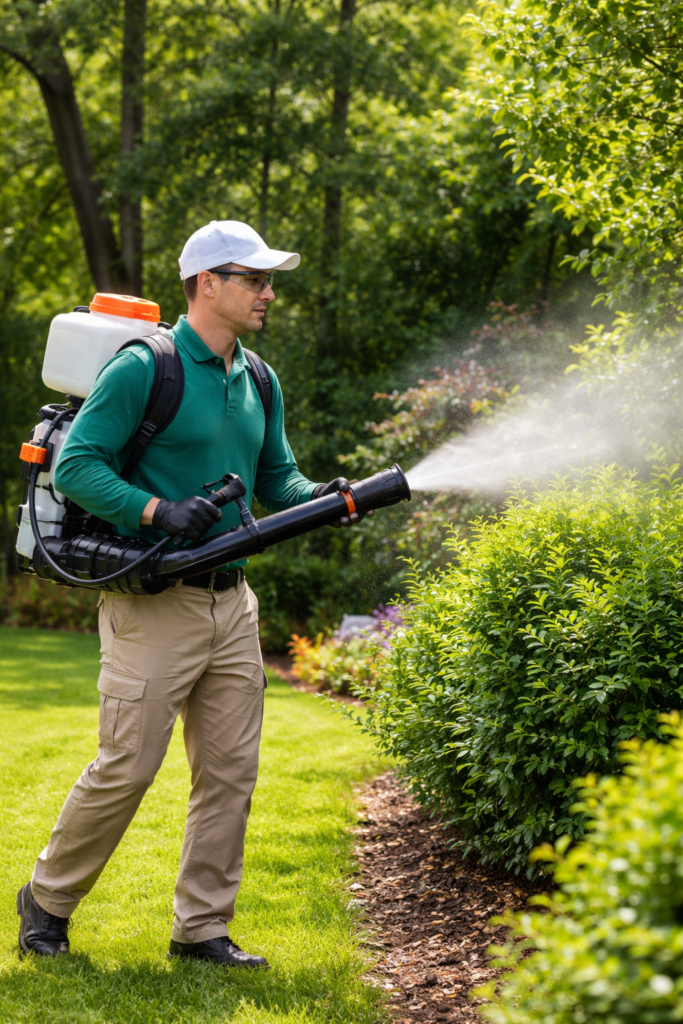
We use a barrier spray treatment applied to the vegetation on your property — the shrubs, ornamentals, ground cover, and perimeter plantings where mosquitoes rest during the day. Adult mosquitoes don’t fly continuously — they spend most of their time resting in shaded, sheltered vegetation, emerging at dawn and dusk to feed.
Our treatment targets those resting sites with a residual product that continues working for 21 days after application. We treat the undersides of leaves, the base of shrubs, tall grass at the property edges, and any other vegetation that creates the cool, shaded resting habitat mosquitoes prefer.
What we treat:
- Ornamental shrubs and foundation plantings
- Ground cover areas (pachysandra, liriope, English ivy)
- Wooded edges and natural areas at the property perimeter
- Tall grass and weeds along fences or property lines
- Shaded areas under decks and porches where mosquitoes rest
What we don’t treat:
- Open lawn areas (mosquitoes don’t rest here — treating it wastes product)
- Vegetable gardens or pollinator-focused plantings (we work around these)
- Active flowering plants where bees are foraging
Treatment Safety: Families, Pets, and Pollinators
We know this is a top concern for Wake Forest homeowners with kids and pets. Here’s what we use and what you need to know:
Our standard treatment uses a synthetic pyrethroid — the same class of chemistry used in most professional mosquito programs. It’s effective against mosquitoes but breaks down quickly in sunlight and is far less toxic to mammals than to insects. The label recommendation is to keep people and pets off treated areas until the product has fully dried, typically 30–60 minutes after application.
We also offer an organic option using plant-based essential oil formulations (primarily clove oil and rosemary oil). The organic treatment degrades faster — it typically provides 14–18 days of protection rather than 21 — and is appropriate for households with very young children, pets that spend extended time in treated vegetation, or homeowners with sensitivity to synthetic chemicals.
We will not treat in a way that puts pollinators at risk. We don’t spray open flowers, we avoid active forager areas, and we schedule treatments to minimize exposure to beneficial insects.
Our Coverage Schedule: April Through October
Mosquito season in Wake Forest effectively runs from late April through October, with peak pressure in June, July, and August when temperatures are highest and breeding is fastest. Our standard program covers this full window:
- First treatment: Late April, as temperatures consistently reach the mid-60s and mosquitoes become active
- Recurring treatments: Every 21 days through October — typically 8–9 applications per season
- Final treatment: October, as temperatures drop and mosquito activity winds down
We also offer one-time event treatments for outdoor parties, graduations, wedding receptions, or other events where you need reliable protection for a specific date.
Combining Mosquito Control With Lawn Care
Many Wake Forest homeowners bundle mosquito control with our fertilization and weed control program. There are practical reasons for this: our applicators are already scheduled to visit your property, and addressing mosquito habitat (overgrown vegetation, dense ground cover) overlaps naturally with overall lawn health management.
A well-maintained lawn with trimmed edges, managed ground cover, and good drainage has fewer natural mosquito resting sites than an overgrown one. The lawn program and the mosquito program work together in a way that a mosquito-only treatment can’t fully replicate.
For more on what we do across the full year for Wake Forest lawns, see our guide to weed control and fertilization in Wake Forest.
Frequently Asked Questions
How soon does the treatment work?
The barrier spray begins working within hours of application. Mosquitoes that contact treated vegetation are eliminated quickly. The residual protection builds over the first 24–48 hours as the product fully cures on the plant surfaces.
Will it rain right after my treatment?
We need 30–60 minutes of dry time after application for the treatment to bond to plant surfaces. If rain is forecast within that window, we’ll reschedule. Light rain after the product has dried doesn’t significantly reduce effectiveness — the treatment is formulated to withstand normal moisture.
Do I need to be home during the treatment?
No. We’ll treat the exterior of your property without you present. We do ask that pets be kept inside or away from the treatment area for 30–60 minutes after application.
How much does mosquito control cost in Wake Forest?
Pricing is based on lot size and the number of applications. The most accurate way to get pricing is a free on-site estimate — we measure the treatable area and give you a clear quote with no surprises.
Can I eliminate mosquitoes completely?
No treatment eliminates 100% of mosquitoes — adult mosquitoes continually move in from surrounding areas. What barrier spray does is dramatically reduce the resting population on your property. Most clients go from genuinely unusable outdoor spaces to comfortable evenings outside within the first treatment cycle.
Ready to Take Your Backyard Back?
We serve Wake Forest, Heritage Wake Forest, Holding Village, Hasentree, Rolesville, Youngsville, and surrounding areas in Wake and Franklin counties.
📞 Call or text: (919) 328-3973
🌐 distinctlawns.com
Get your free estimate and find out what a full season without mosquitoes feels like.