

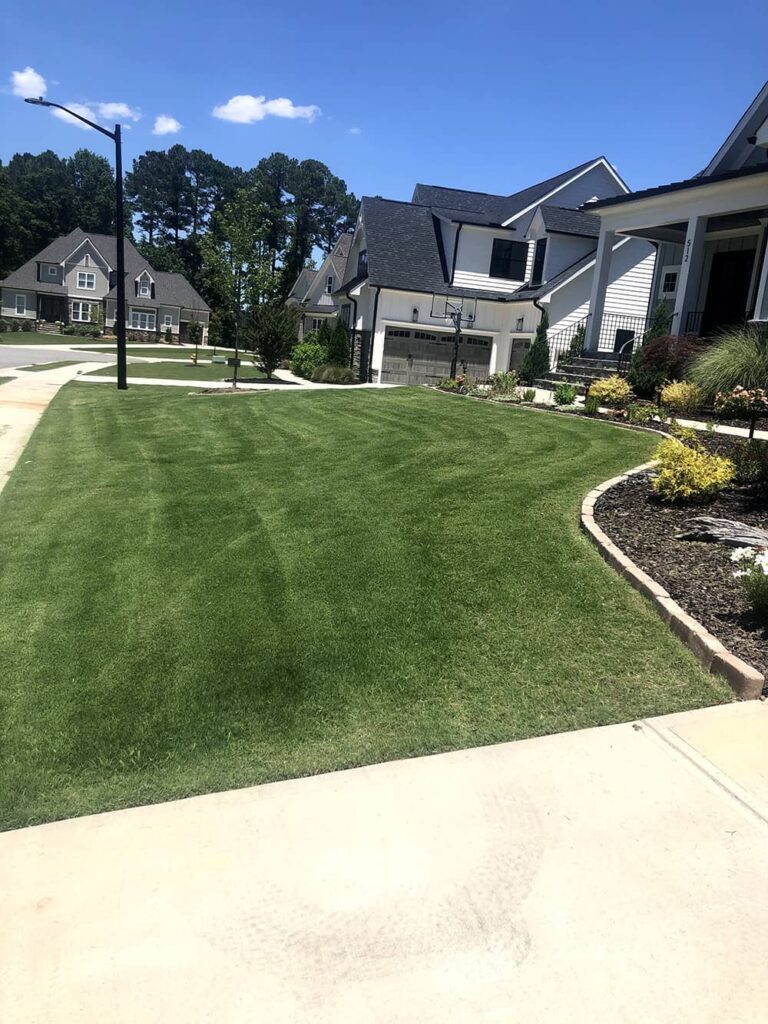
Lawn Fertilization & Weed Control Service in Franklinton, NC
Franklinton lawns come with a set of challenges that generic lawn care programs aren’t built for. The clay soil that runs through most of Franklin County is some of the heaviest in the Triangle region — it compacts easily, drains poorly, and locks up nutrients in ways that make standard fertilization schedules underperform. Add a mature tree canopy in many older neighborhoods, and you’ve got the conditions for persistent weeds and thin turf that’s hard to turn around without the right approach.
Distinct Lawns is based in Franklinton. We know this soil, we know these streets, and we know the specific weeds that show up on E. Mason Street just as reliably as they do out on the NC-56 corridor. Our fertilization and weed control programs are designed around what Franklinton lawns actually need — not what works in a newer suburb with different soil and younger trees.
The Franklinton Lawn Challenge: What Makes This Soil Different
Franklin County clay is notorious among local lawn professionals. It’s dense, poorly aerated, and has a natural tendency to run acidic — typically in the 5.3 to 5.8 pH range. Most lawn grasses want soil between 6.0 and 7.0. When the pH is off, the grass can’t absorb nutrients efficiently even if you apply the right fertilizer at the right time. You end up paying for products that the lawn literally cannot use.
The fix is lime — but lime applied to heavy clay takes time to work. It needs to be incorporated into the soil and given a full growing season to begin correcting the pH. This is why Franklinton lawns often need two to three seasons on a proper program before they reach their full potential. The grass was never getting the benefit of what was applied to it, and correcting that takes patience and consistent management.
Compaction is the other issue. In established Franklinton neighborhoods where the same lawns have been walked on for decades, the clay has had time to compress under the surface. Compacted soil restricts root growth and surface water absorption — the grass sits on top of ground it can’t properly root into, and any rain that falls tends to run off rather than soak in. We typically recommend core aeration for established Franklinton lawns, often in the second year of a program once the soil chemistry is starting to improve.
The Weeds We See Most in Franklinton Yards
Weed populations in Franklinton reflect the local conditions: heavy soil, mature tree cover, and a mix of established Bermuda and cool-season Fescue lawns.
Wild Violet
Wild violet is the number one weed complaint we hear from Franklinton homeowners. It thrives in exactly the conditions Franklinton has: shaded areas under mature trees, acidic soil, and consistent moisture. Wild violet is extraordinarily difficult to control — it has waxy leaves that repel most standard broadleaf herbicides. Effective treatment requires products containing triclopyr, applied in fall when the plant is actively moving resources into its root system. Multiple fall treatments over two seasons are typically needed for heavy infestations.
Crabgrass and Goosegrass
In the sunnier areas of Franklinton yards, crabgrass fills the thin spots every summer without fail. Clay soil compaction contributes to this — thin, stressed turf is more vulnerable to crabgrass than dense, healthy grass. Pre-emergent herbicide applied before soil temperatures hit 55°F is essential. We time this to the local climate, typically targeting late February to mid-March in Franklinton depending on the year.
Nutsedge
Nutsedge — sometimes called nutgrass — appears in areas with drainage issues, which are common in Franklinton’s clay-heavy lots. It grows faster than surrounding turf, looks like grass, and reproduces through underground tubers that are nearly impossible to remove mechanically. We treat it with Celsius WG or sulfentrazone-based products, depending on your grass type, over multiple applications through the growing season.
Clover and Common Chickweed
Both thrive in the cool, moist conditions of Franklinton springs and the nitrogen-poor soils common in lawns that haven’t been on a proper fertilization program. A good fertilization program that builds turf density is part of the long-term solution — thick grass simply doesn’t give clover and chickweed the space they need to establish.
Our Fertilization Program for Franklinton Lawns
Our five-round program for Franklinton is calibrated around the specific grass types and soil conditions we encounter here.
For Bermuda and Zoysia (Warm-Season):
We start with a pre-emergent in late February to early March, paired with a light starter fertilizer as the grass comes out of dormancy. Spring brings the first full feeding along with broadleaf weed control. Summer rounds provide the high nitrogen that Bermuda needs during its peak growing period. We close the season with a potassium-focused winterizer application in October and assess soil pH for lime adjustments.
For Tall Fescue (Cool-Season):
Franklinton’s mature tree canopy means a significant portion of local yards have Fescue or Fescue/Bermuda mixes. Fescue needs its primary fertilization in September — the most important application of the year — when it’s recovering from summer stress and building root depth ahead of winter. We apply a slow-release nitrogen blend in September, a secondary feeding in November, and a light spring application in March. We are careful not to push Fescue with nitrogen in summer — it’s dormant and fertilizing during heat stress invites brown patch disease, which is extremely common in the Triangle.
What to Expect from Year One
Most Franklinton homeowners see meaningful improvement in year one — reduced weed pressure, better turf color, fewer bare spots. But the biggest transformation typically comes in year two, once the soil pH is moving in the right direction and the turf has had a full season on a proper feeding schedule.
We’ll give you an honest assessment after the first season: what improved, what still needs attention, and what the plan is for year two. That might include a lime application to address pH, a recommendation for aeration if compaction is limiting progress, or a shift in product timing based on what we observed in your specific yard.
Frequently Asked Questions
Do I need a soil test before starting a program?
We do a basic soil assessment during our initial evaluation. For lawns with serious pH issues or persistent fertilization failures, we recommend a full soil test through the NC Department of Agriculture — it costs a few dollars and tells you exactly where your pH stands and what amendments your soil needs. We use those results to build a more targeted program.
My lawn has been neglected for years. Is it too far gone?
Rarely. Most neglected lawns in Franklinton have Bermuda that’s been suppressed by weeds and poor soil but isn’t dead. Bermuda is aggressive — given the right program, it will fill back in. If large areas have died completely, sod installation may be the faster path. We’ll tell you honestly which situation you’re in during the free estimate.
Do you serve areas outside Franklinton proper?
Yes. We serve the full Franklinton area including surrounding unincorporated Franklin County, Youngsville, Creedmoor, and Wake Forest. If you’re in the area and want to confirm coverage, just call or text us.
How does pricing work?
Pricing is based on lawn size. We measure during the free estimate and price per square foot per application. No contracts required — you can start with a single application if you want to see results before committing to a full program.
Serving Franklinton and Franklin County
Distinct Lawns is a Franklinton-based company. When we say we know this area, we mean it — we’re not a Charlotte franchise with a satellite office here. We’re treating lawns on E. Mason Street, Pearce Road, and out past the 96 bypass every week.
If you want to understand more about the products and timing behind what we do, see our guide to lawn fertilization services and our weed control program. We also offer mosquito control in Franklinton for homeowners who want to take their outdoor space back through the summer months.
📞 Call or text: (919) 328-3973
🌐 distinctlawns.com
Get your free lawn assessment — we’ll come out, evaluate your soil and turf, and put together a program that’s specific to your Franklinton yard.